Need help? Click to chat with our experts ->
SOLUTION / 03 · Microgrid
Multi-strategy Stacking

Microgrid
Solution

One storage system, multiple revenue streams.

Hero Image
01 / The Problem

Storage doing one thing is a waste

Arbitrage alone means long payback; demand control alone leaves storage idle most of the time. Good revenue windows vanish in seconds, and no one can watch them by hand.

Pain Point 01

Single revenue, long payback

Arbitrage alone in regions with narrow price spreads means a 7-10 year payback. Stacking multiple streams compresses it to 3-5 years or less.

Single revenue, long payback
Long payback Idle asset

Pain Point 02

Revenue windows vanish in seconds

Frequency regulation appears and disappears in seconds; demand response gives 30 minutes' notice. Mixed time scales make manual judgment impossible.

Revenue windows vanish in seconds
Second-level signals Manual can't keep up
Pain Point 03

Policy windows are limited

VPP and distributed storage participation is a global trend, but rules keep changing. Early movers capture the rule dividend; latecomers see margins squeezed.

Policy windows are limited
Short window First mover advantage
02 / Traditional Approach

Earning one way, low asset utilization

Storage can only discharge once at a time, but that does not mean it can only earn one way. A single strategy wastes most of the time window.

Option A Single revenue

Arbitrage only

Charge off-peak, discharge at peak, fixed schedule. With narrow spreads, payback runs 7-10 years.

Revenue source Price spread only
Asset utilization Low
Payback 7-10 years
Option B Single revenue

Demand control only

Monthly demand shaving only, revenue from demand charge savings. Storage sits idle the rest of the time.

Revenue source Demand charges only
Asset utilization Medium
Payback 3-5 years

The real answer: one smart EMS switching between revenue streams in real time, so storage always executes the highest-value strategy.

03 / Our Solution

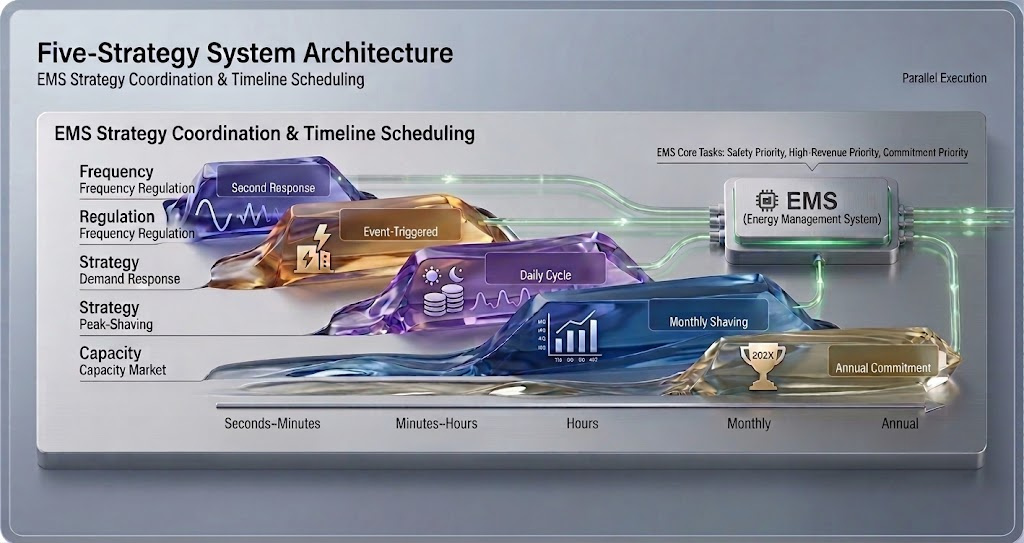
EMS-driven, five strategies stacked

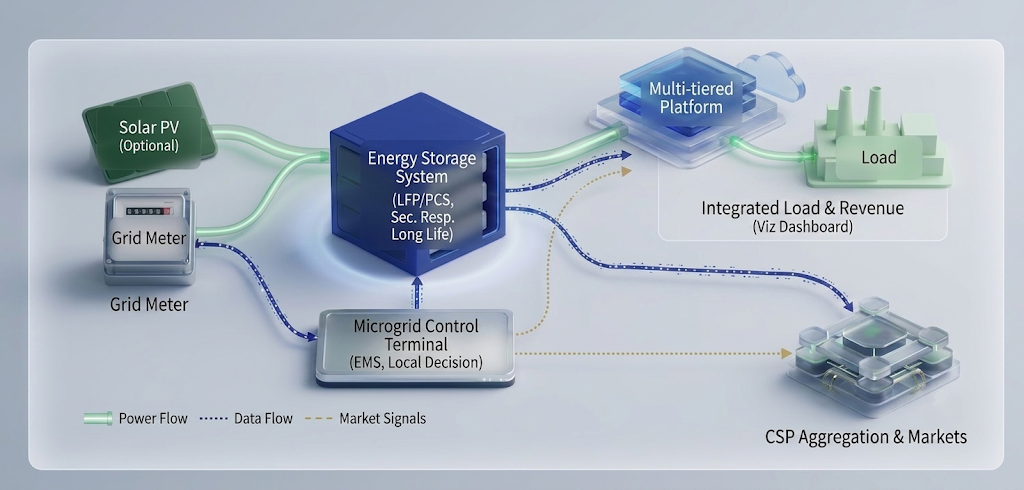
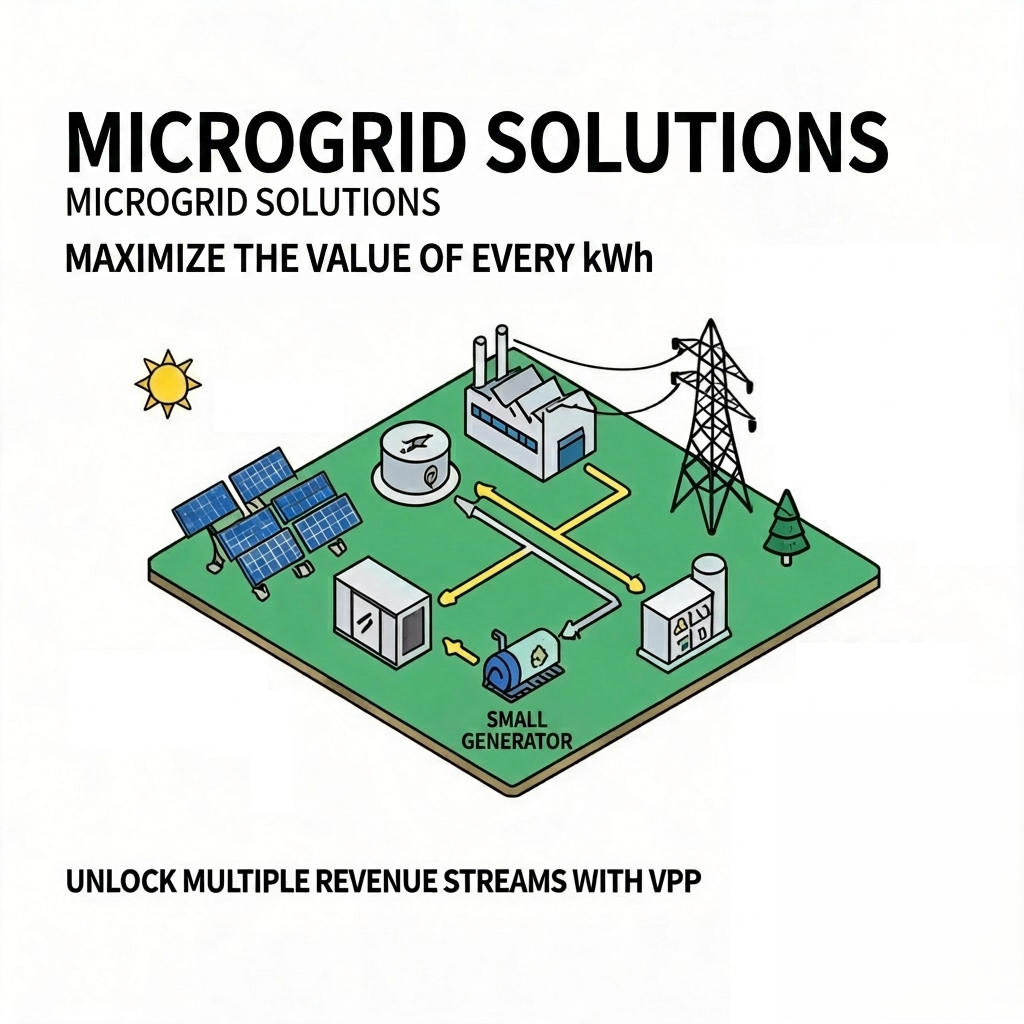
Demand control, arbitrage, demand response, frequency regulation, and capacity market. Five streams separated on the time axis, stacked on one system.

Base Layer

Demand + Arbitrage

Auto-enters arbitrage when demand is safe, auto-exits as demand nears the threshold. No manual intervention.

Enhancement Layer

DR + Frequency

Participate in demand response and frequency regulation via an aggregator. Even with zero events all year, capacity payments still arrive.

Long-term Layer

Capacity Market

Annual auction commitment to be available at grid peaks, paid yearly. EMS keeps storage fully charged and ready in key windows.

System Architecture

System Architecture
04 / Key Equipment

EMS is the fundamental difference

Single solutions run on fixed rules; the microgrid solution switches between strategies in real time with dynamic optimization.

Equipment 01 · Physical

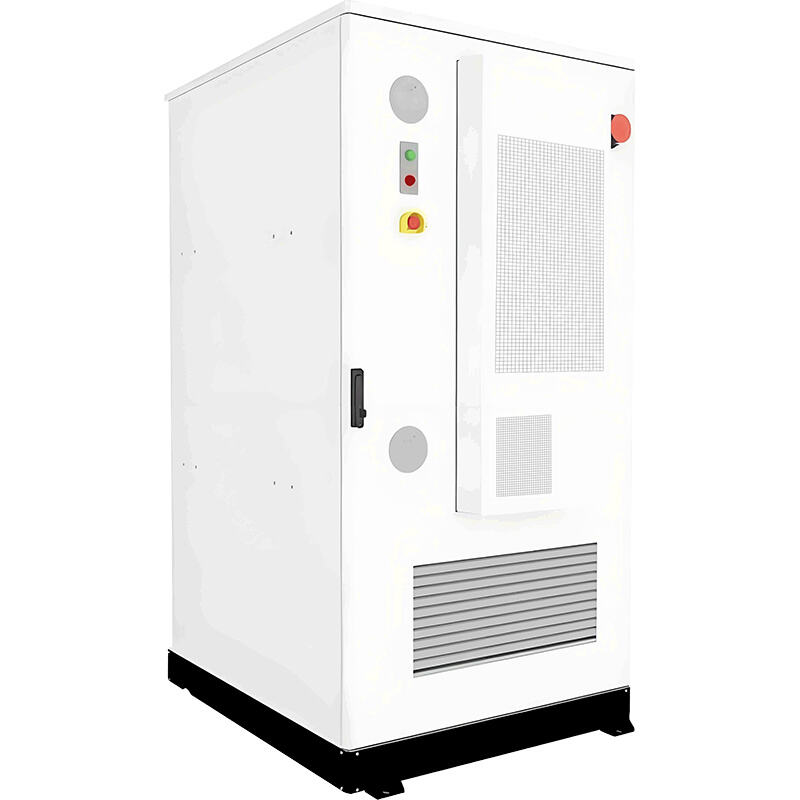
Storage System

Faster response (second-level for frequency) and longer cycle life (higher dispatch frequency). LFP cells, 6,000-8,000 cycles.

Storage System
Air/Liquid Cooled Second-level Response Long Cycle Life
Equipment 02 · Brain

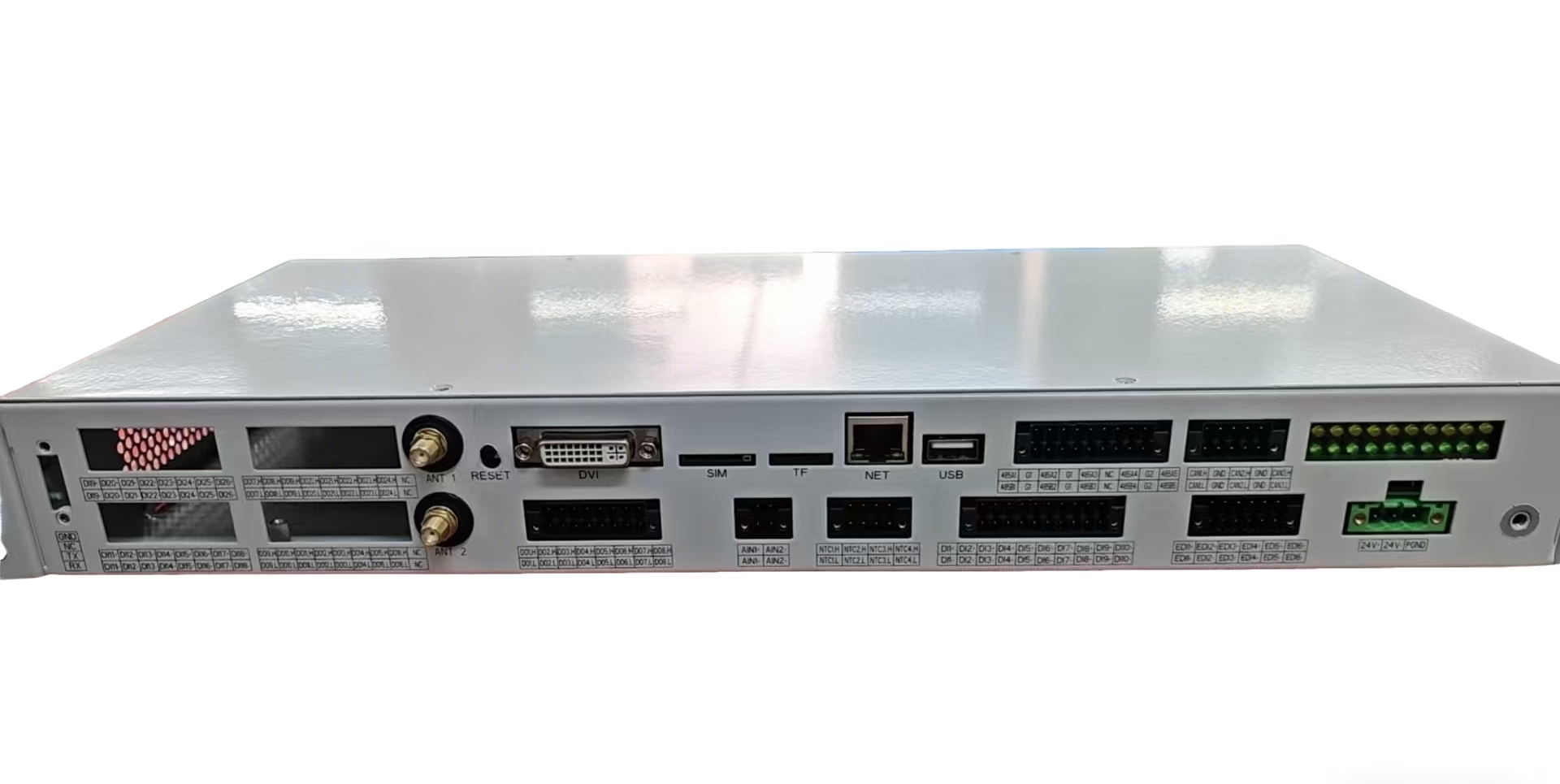
Microgrid Controller EMS

The fundamental difference of the microgrid solution. Monitors market signals 24/7 and makes millisecond-level optimal dispatch.

Microgrid Controller EMS
Demand Control Arbitrage Dispatch Strategy Arbitration
Equipment 03 · Operations

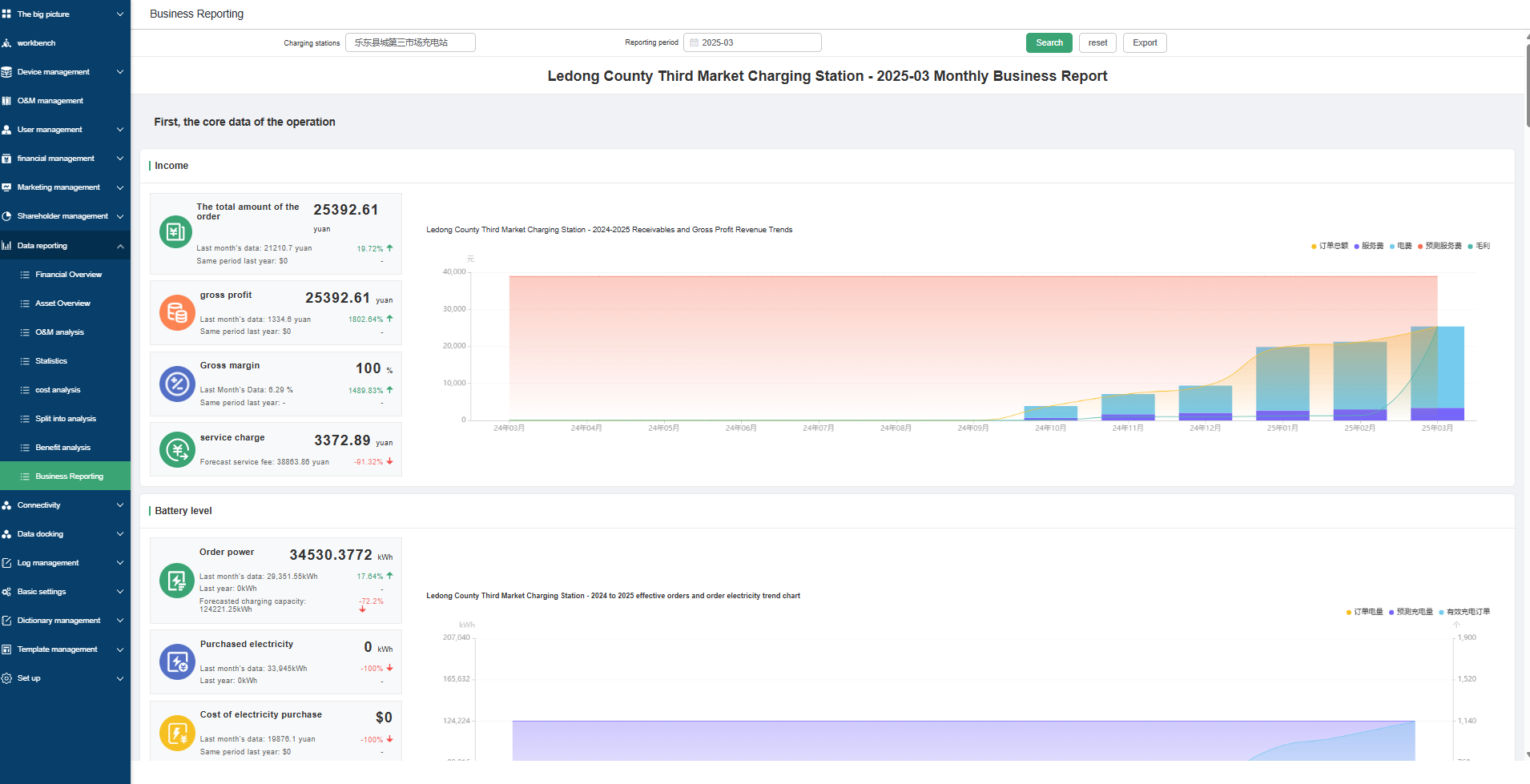
Cloud Platform

Independent accounting and visualization of each revenue stream. Remote strategy configuration and OTA upgrades.

Cloud Platform
Revenue Accounting Trend Analysis Aggregator API
Closed Loop
05 / Project Process

Five stages, from inquiry to delivery

Includes electricity market research and aggregator integration, ensuring the multi-revenue model stands up economically.

01

Project Inquiry

Project Inquiry
02

Site Measurement + Market Research

Site Measurement + Market Research
03

Multi-revenue Model Analysis

Multi-revenue Model Analysis
04

Deployment + Aggregator Integration

Deployment + Aggregator Integration
05

O&M Support

O&M Support
06 / Case Study

US Silo Inn, 3-year payback

The benchmark case of multi-revenue stacking for commercial users. A 125kW system stacking demand, arbitrage, and PJM ancillary services earns over $30k yearly.

Annual Revenue
$34k
Year 1 (incl. one-time incentive)
Payback
3yr
After ITC net investment
Full-investment IRR
32%
Internal rate of return
Case Image
Case Image
Engineers online · Reply within 24h

Need a Custom Solution for Your Site?

Tell us about your grid capacity, charging goals, or scenario. We will recommend the optimal solar / storage / charging configuration — tailored, no obligation.