Off-Grid vs On-Grid vs Hybrid Solar Systems
Choosing between off-grid, on-grid, and hybrid solar depends on three factors: your grid reliability, your energy cost, and whether you need backup power. For industrial and commercial buyers, the wrong choice can mean lost production, higher costs, or unnecessary capital spending.
On-Grid Solar System
An on-grid solar system is connected to the public utility grid. It generates power during the day and exports surplus to the grid. When solar output is low, the facility draws power from the grid.
Best for: Stable-grid locations where the goal is to reduce electricity bills.
Pros:
– Lower upfront cost
– Can sell surplus power where net metering exists
– Simple maintenance
Cons:
– No backup power during grid outages
– Exported surplus may be credited at low rates
– Cannot operate when grid is down
Off-Grid Solar System
An off-grid solar system operates independently from the utility grid. It relies on solar panels, a battery bank, and often a backup generator to provide 100% of the site’s power.
Best for: Remote locations, islands, mining camps, and areas with no grid access or extremely unreliable grids.
Pros:
– Complete energy independence
– No grid connection fees
– Reliable power in remote locations
Cons:
– Higher upfront cost due to larger battery bank
– Requires accurate load forecasting
– Backup generator often needed for rainy seasons
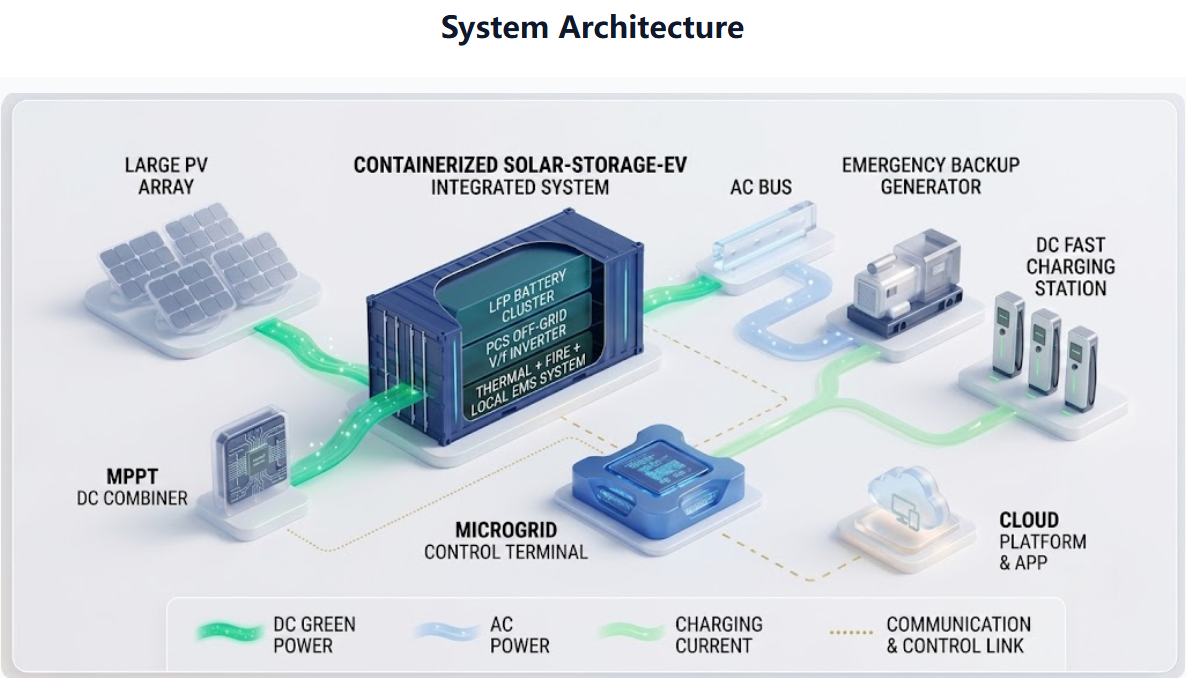
Hybrid Solar System
A hybrid solar system combines solar, battery storage, and a grid connection. It can operate in on-grid mode, off-grid mode, or a mix of both.
Best for: Industrial sites in emerging markets with unstable grids that want both bill savings and backup power.
Pros:
– Backup power during outages
– Solar self-consumption optimization
– Can export surplus when grid is available
– Smooth transition between grid and battery
Cons:
– Higher upfront cost than pure on-grid
– More complex design and control
Quick Comparison Table
– On-Grid: Grid connection yes, backup no, battery optional, typical use case stable grid bill savings, upfront cost low
– Off-Grid: Grid connection no, backup yes, battery mandatory, typical use case remote site no grid, upfront cost high
– Hybrid: Grid connection yes, backup yes, battery mandatory, typical use case unstable grid backup needed, upfront cost medium-high
Which One Should You Choose?
– Stable grid + cost reduction goal → On-grid or on-grid + BESS
– Remote site or no grid access → Off-grid solar + BESS + generator
– Unstable grid + need backup → Hybrid solar + BESS
– Peak demand penalties → Hybrid with peak shaving control
Get a Custom Solar + Storage Solution
Hoston Energy designs off-grid, hybrid, and grid-tied solar + storage solutions for industrial projects across 132+ countries.