Types of Energy Storage Systems Compared
Not every energy storage technology fits every project. For industrial and commercial buyers, the choice usually comes down to scale, response speed, cycle life, and total cost of ownership. This guide compares the main types of energy storage systems used in real projects today.
1. Battery Energy Storage System (BESS)
Battery storage — especially Lithium Iron Phosphate (LFP) — is the most flexible option for commercial and industrial facilities. It responds in milliseconds, scales from 100 kWh cabinets to multi-MWh containers, and integrates easily with solar and grid meters.
Pros: Fast response, modular, proven technology, declining cost
Cons: Battery degradation over time, requires thermal management
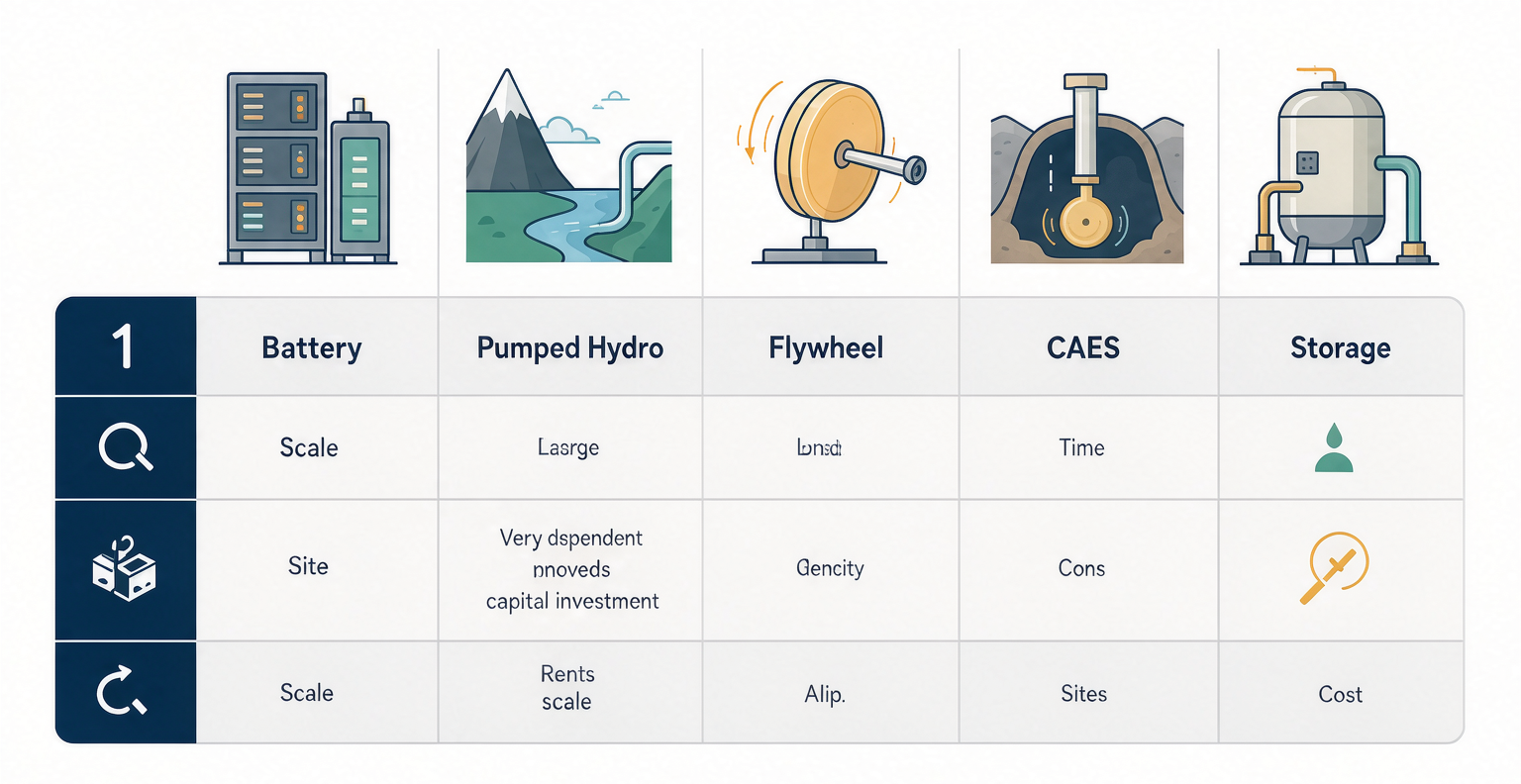
2. Pumped Hydro Storage
Pumped hydro stores energy by moving water between two reservoirs at different elevations. It is the largest form of grid storage globally but requires specific geography and massive capital investment.
Pros: Very large capacity, long lifespan
Cons: Site-dependent, long construction time, not suitable for factories or commercial sites
3. Flywheel Energy Storage
Flywheels store kinetic energy in a spinning rotor. They excel at very fast charge/discharge cycles but only for seconds or minutes.
Pros: Extremely fast response, long cycle life
Cons: Low energy density, not suitable for backup power or peak shaving
4. Compressed Air Energy Storage (CAES)
CAES stores energy by compressing air into underground caverns or tanks. It is efficient at scale but limited by geography and infrastructure.
Pros: Long duration, large scale
Cons: Limited suitable sites, slow ramp rate
5. Thermal Energy Storage
Thermal storage stores energy as heat or cold. It is common in HVAC systems but does not store electricity directly.
Pros: Simple, low maintenance
Cons: Application-specific, cannot power electrical loads
Which Energy Storage System Should You Choose?
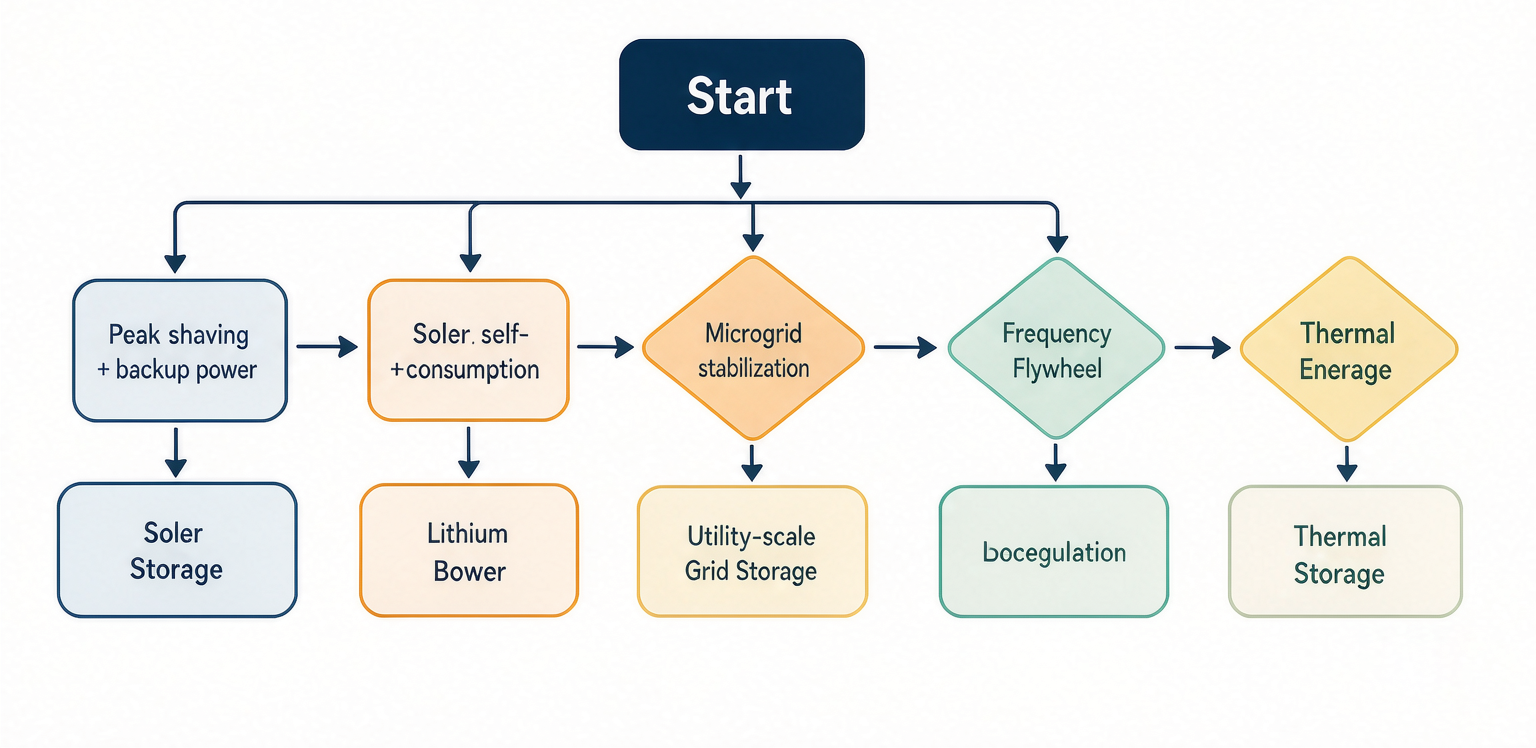
For most industrial and commercial projects, the decision matrix looks like this:
– Peak shaving + backup power → Lithium BESS
– Solar self-consumption → Lithium BESS
– Microgrid stabilization → Lithium BESS + optional flywheel
– Utility-scale grid storage → Pumped hydro or CAES
– Frequency regulation only → Flywheel
– Process heat/cooling → Thermal storage
Why Lithium BESS Dominates Industrial Projects
Lithium BESS is the default choice for factories, warehouses, data centers, and commercial buildings because it:
– Fits indoors or outdoors in standard containers
– Scales modularly as energy needs grow
– Provides both power and energy capacity
– Integrates with existing solar and generators
– Has a clear 10-year TCO model
Find the Right Energy Storage System
If your project needs peak shaving, backup power, or solar integration, a lithium BESS is likely the right fit.